








Mobile data in Mauritania: what to expect
Mauritania is a vast, sparsely-populated country where the Sahara fills most of the map and mobile coverage clings to the Atlantic coast and the few inland towns. The operators — Mauritel, Chinguitel and Mattel — provide 4G that works in the capital and the larger settlements, enough for maps, WhatsApp messaging and the occasional photo upload, but data here is best understood as a way to stay reachable rather than to stream. The capital Nouakchott and the northern fishing port of Nouadhibou have the most reliable signal. A travel eSIM is the sensible option: it activates the moment you arrive, avoids a steep roaming bill from your home carrier, and means no hunting through a market for a local SIM and the registration that comes with it.
Coverage across the country
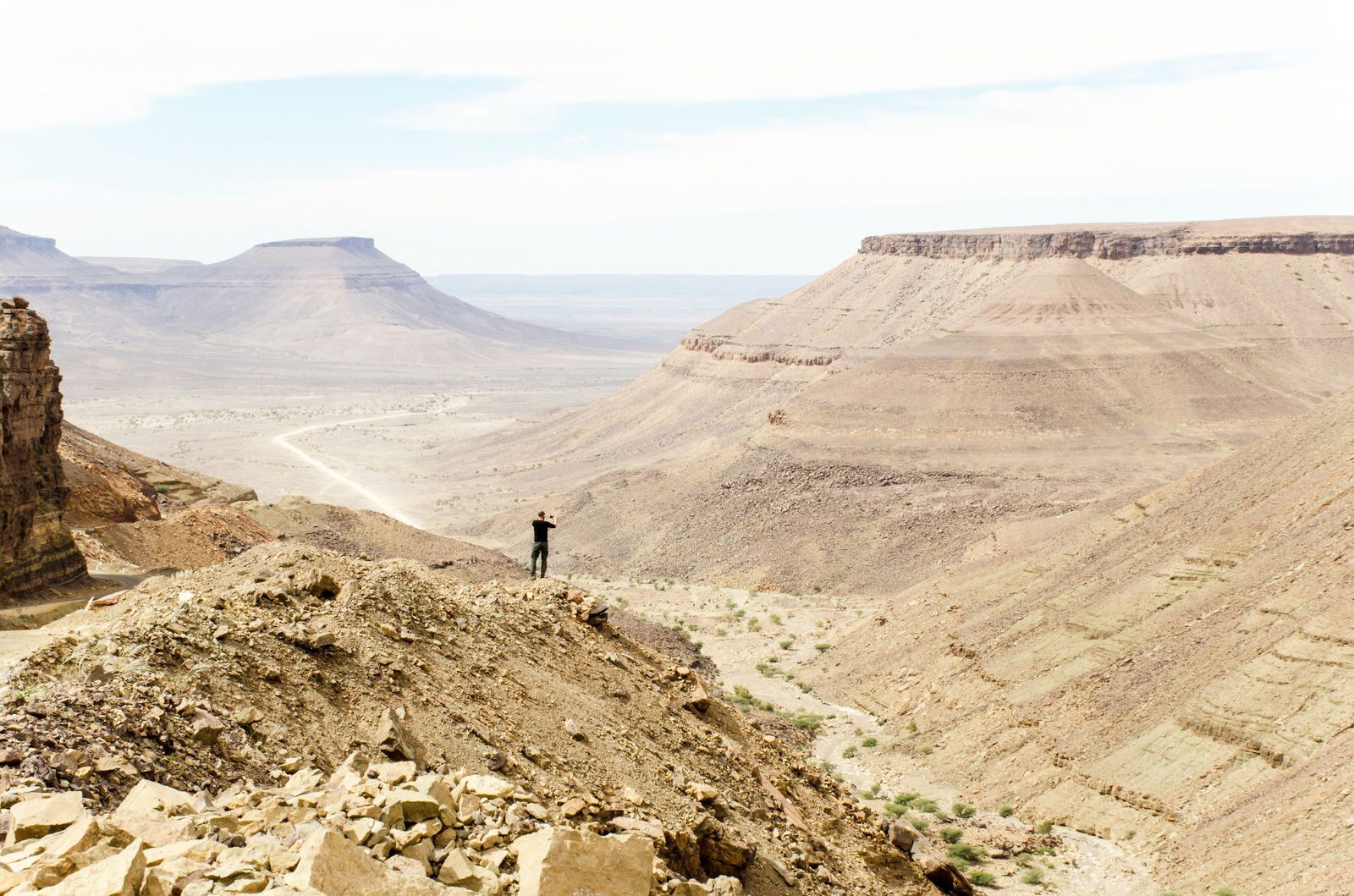
Expect usable 4G in Nouakchott, in Nouadhibou up on the Cap Blanc peninsula, and in the regional towns strung along the main roads — Rosso at the Senegal River border crossing, Kiffa and Aleg on the Route de l'Espoir running east, and Atar, the gateway to the Adrar plateau. Signal follows the paved corridors and the coast. Where it falls away to little or nothing: the open desert interior, the historic caravan towns of Chinguetti and Ouadane out in the Adrar, the long iron-ore railway line between Nouadhibou and the mining town of Zouerat, and the empty tracks toward the Mali and Algeria frontiers. If your trip runs deep into the Sahara — the Adrar oases, the Banc d'Arguin coast with its vast seabird colonies, or the desert pistes toward Chinguetti's old libraries — plan to be offline for long stretches and never rely on live data for navigation out there. Even on the main coastal highway between Nouakchott and Nouadhibou there are quiet sections where signal drops between towns, so a downloaded map is your real backup rather than the network.
How much data you'll need
Travel here is genuinely light on data. Most visitors lean on WhatsApp for keeping in touch and arranging guides, Google Maps or Maps.me for the towns, and a translation app since Arabic and French dominate and English is limited. A short stay around Nouakchott and the coast usually fits comfortably inside a few GB. A one-to-two-week trip taking in Nouadhibou, the Adrar plateau and some overland travel typically runs in the mid-single-digit to low-teens GB range — that is mostly because navigation and messaging are constant while connectivity itself is sporadic, not because you'll be streaming. Download offline maps before you go; they cover the long gaps and save data. The plans above let you choose a size to match how connected you actually need to be.
Keep your number and WhatsApp
A dual-SIM phone lets the eSIM carry your data while your normal SIM stays active for calls, SMS and bank one-time codes. WhatsApp keeps running on your existing number, so contacts and local guides reach you exactly as before. The one setting that matters: switch your home SIM's data roaming off, so it can't quietly rack up per-megabyte charges in the background while the eSIM does the work. WhatsApp is the standard way guides and lodges in Mauritania stay in touch, so keeping it live on your usual number is worth it.
Before you fly
First confirm your handset supports eSIM — most iPhones from the XR onward, plus recent Samsung Galaxy, Google Pixel and other flagships. Our compatibility checker tells you in seconds. Install the eSIM while you're still on home Wi-Fi; it stays dormant and activates when you reach Mauritania, typically as you land at Nouakchott-Oumtounsy International (NKC) or fly into Nouadhibou (NDB). Setting it up beforehand means you step off the plane already connected. If Mauritania is one leg of a wider West African route, check whether a neighbouring hub such as Senegal fits the rest of your trip better.
Good to know: the iron-ore train
One of Mauritania's signature experiences is riding the iron-ore train — one of the longest freight trains in the world — across the desert between Nouadhibou and Zouerat. It is spectacular and almost entirely offline: there is no usable signal for most of the route, so treat the whole journey as a disconnected adventure rather than something you can navigate or share in real time. A practical tip more broadly: download anything you might need — maps, translation phrasebooks, ticket confirmations — while you still have signal in town, because once you head into the interior you may not see a bar for hours.