
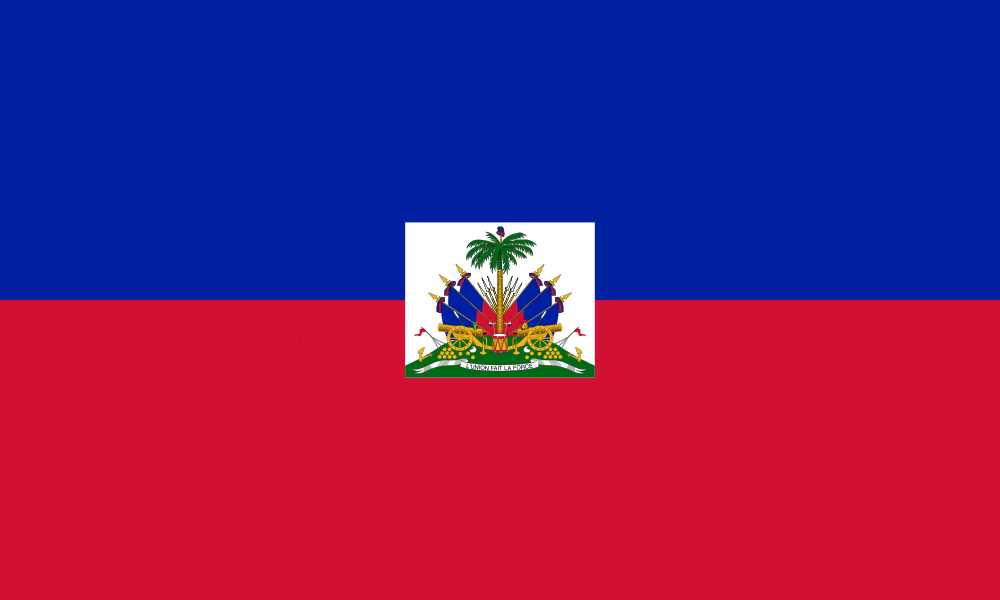









Using mobile data in Haiti: what to expect
Mobile data is the backbone of staying connected in Haiti, where fixed broadband is limited and most people rely entirely on their phones. The networks offer 4G/LTE in the capital and major towns, with coverage built around the population centres. Reliability can vary with local conditions, and power or infrastructure disruptions occasionally affect service even where the network reaches — that's the honest picture, and it's worth planning around rather than assuming a constant connection.
A travel eSIM is a practical choice here precisely because it removes friction. It activates on arrival, runs over a roaming partner, and gets you online without sourcing a local SIM in a market where that isn't always straightforward or comfortable for a short-stay visitor. For aid workers, members of the diaspora visiting family, and business travellers, having data the moment you land is genuinely useful — you can confirm a pickup, message ahead, or pull up a map before you even leave arrivals. And because the price is fixed up front, there's no roaming bill waiting for you back home.
Coverage across Haiti
Coverage is strongest in and around Port-au-Prince and the surrounding metropolitan area, including Pétion-Ville and Delmas. Beyond the capital you'll find usable service in the regional centres: Cap-Haïtien on the north coast, Les Cayes in the south, Gonaïves and Saint-Marc in the Artibonite, and the artsy seaside town of Jacmel on the southern coast. The main routes between cities carry signal through the populated stretches.
Where coverage thins out is the mountainous interior — Haiti is famously rugged, and the Taíno-derived name itself means "land of mountains" — along with remote rural communes and the more isolated coastal areas. If you're heading into the hills, up to the Citadelle Laferrière near Cap-Haïtien, out to Île-à-Vache off the south coast, or to a remote project site, plan for stretches without signal and cache everything you'll need in advance: maps, contacts, offline documents and any translations between French, Haitian Creole and your own language. Bear in mind too that Haiti sits in the hurricane belt, with the Atlantic season spanning June to November; storms can interrupt service, so offline backups of your essentials are simply good practice. Treat the towns as your reliable connection points and don't count on continuous service between them.
How much data you'll need
Communication in Haiti runs heavily on WhatsApp, with Facebook and Messenger also widely used for both personal and business contact, so messaging will be a big share of your data. Around that you'll use email, maps for navigating Port-au-Prince's heavy and unpredictable traffic, and voice or video calls over data to stay in touch with people back home. A short stay focused on messaging and the occasional call fits a small allowance comfortably. A one-to-two-week trip with daily uploads, navigation and regular video calls is better matched to a mid-size bucket from the plans above. If you expect to stream or make long video calls every day, size up rather than risk running dry mid-trip — and set up offline maps before you arrive so navigation never depends on a marginal signal.
Keep your number and WhatsApp
Dual-SIM lets your phone run the eSIM and your home SIM together. The eSIM carries the data; your usual number stays live for calls, SMS and the security codes your bank sends; and WhatsApp keeps running on your home number, so family and colleagues reach you with no change and nothing to re-register. Be sure to switch your home SIM's data roaming off in settings — that prevents your home carrier from billing roaming charges in the background while the eSIM quietly handles all your data.
Before you fly
Check eSIM support first — most iPhones from the XR onward, plus recent Samsung, Pixel and Honor phones, qualify — via our compatibility checker, so there are no surprises at the gate. Install the profile on Wi-Fi before you travel so there's nothing to configure on the ground; it then activates when you land at Toussaint Louverture International (PAP) in Port-au-Prince or Hugo Chávez International (CAP) in Cap-Haïtien. If your trip pairs Haiti with the other side of Hispaniola, a separate plan for the Dominican Republic keeps you connected there on the same phone, with no SIM swap at the border.