








Mobile data in Costa Rica: the real picture
Costa Rica is one of the better-connected countries in Central America, and for a destination built around national parks and beach towns that's genuinely useful. Three operators — the state-owned Kolbi (run by ICE), plus Claro and Liberty — share the market, and between them 4G/LTE reaches the Central Valley, both coasts and the main tourist corridors. 5G has been rolling out in and around San José and the larger towns. For a traveller this means maps, ride-hailing, translation and messaging all work smoothly in the places you'll spend most of your time. A travel eSIM fits the typical Costa Rica itinerary well: you arrive connected, skip the roaming surcharge entirely, and don't lose an afternoon buying a local SIM when you'd rather be on the road to Arenal.
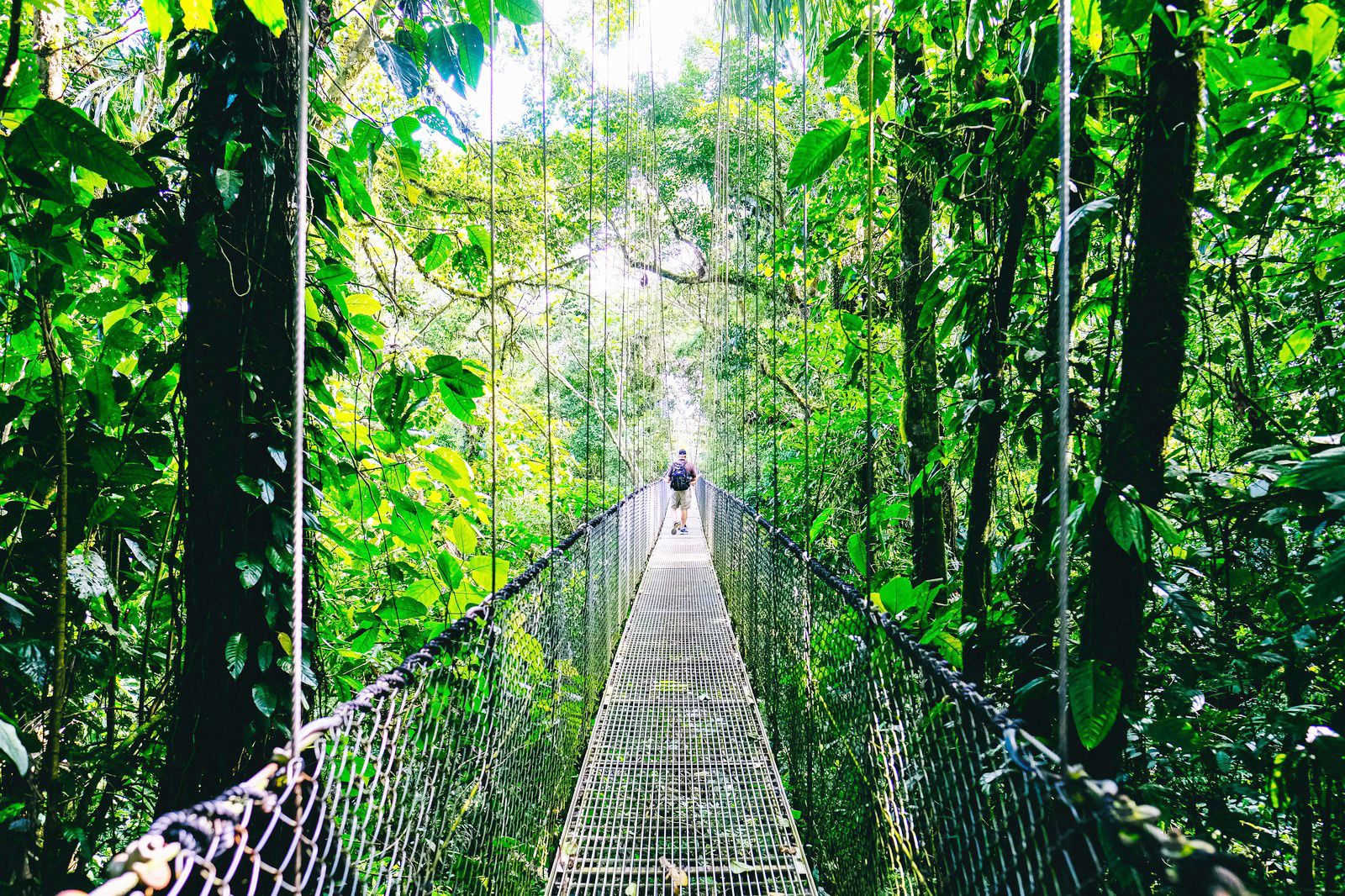
The country's appeal — rainforest, cloud forest, volcanoes, two coastlines — also defines where the network stops, so it pays to know the pattern before you go rather than discovering a dead zone halfway up a mountain road.
Coverage across Costa Rica
The Central Valley has the strongest, densest coverage: San José, Alajuela, Heredia and Cartago are all well served. The Pacific tourist towns are reliable too — Tamarindo, Jacó, Quepos and Manuel Antonio, Nosara and the Nicoya Peninsula resort areas, plus La Fortuna at the foot of the Arenal volcano. The Caribbean side around Puerto Viejo and Cahuita has coverage as well, though it can run thinner than the equivalent Pacific spots.
Where it genuinely drops off is deep inside the protected forest. Expect little to no signal in the heart of Corcovado National Park on the remote Osa Peninsula, across stretches of Monteverde's cloud forest, on the higher mountain roads, and on the river and boat transfers to places like Tortuguero, which you reach by canal rather than highway. The winding routes over the central cordillera also have dead zones between towns, which is exactly where you'll most want navigation. The practical fix is simple: download offline maps for your route and your parks before you set out, and don't count on a live signal during a wildlife hike. A guide's local knowledge replaces the network in those places anyway.
How much data you'll need
Costa Rican travel is fairly data-light. The everyday apps are Google Maps and Waze for the famously winding roads, WhatsApp for booking tours and shuttles — it's how most operators here actually communicate — Uber in and around San José, plus Google Translate and the usual photo uploads. As a rough guide: a long weekend around the capital and a nearby volcano runs on 3–5 GB; a typical one-to-two-week loop taking in Arenal, Monteverde and a Pacific beach sits around 8–15 GB; heavy social posting or daily video calls home push you toward an unlimited-style plan. The plans above cover the usual trip lengths, and because you're on a travel eSIM rather than default roaming, that data costs what the plan says — nothing more, with no surprise per-megabyte charges waiting at the end of the month. One practical note: download your route maps and any park trail data over hotel Wi-Fi the night before, so a dead zone on a mountain road never leaves you guessing at a junction.
Keep your number and WhatsApp
Run the travel eSIM next to your normal SIM (dual-SIM): the eSIM handles your Costa Rica data while your home number stays available for calls, SMS and bank verification codes. WhatsApp — which you'll use constantly here for tours, transfers and restaurant bookings — stays linked to your existing number no matter which line is carrying the data, so the people coordinating your trip reach you on the number they already have. Just turn your home SIM's data roaming off so it can't run up charges in the background while the eSIM quietly does the work.
Before you fly
Check your phone supports eSIM — most iPhones from the XR on, plus recent Samsung, Pixel and Honor handsets; the compatibility checker confirms in seconds. Install on home Wi-Fi before departure so everything's ready to go, and it activates on landing at San José's Juan Santamaría (SJO) or Liberia's Daniel Oduber Quirós (LIR), the gateway for the Guanacaste beaches. If Costa Rica is one stop on a wider Central American route through Panama or Nicaragua, it's worth checking whether a multi-country plan covers the whole trip on one eSIM instead.