









Using mobile data in the Faroe Islands: better than the remoteness suggests
For a windswept archipelago marooned in the middle of the North Atlantic, the Faroes are remarkably well connected. Two operators — Føroya Tele (which sells to consumers under the Hey brand) and Vodafone Faroe Islands — cover the inhabited islands with strong 4G, and crucially the sub-sea road tunnels that link the main islands are wired, so you stay online even while driving underground beneath a fjord. The one thing to understand before you travel: the Faroe Islands are an autonomous part of the Kingdom of Denmark but sit outside the European Union, so EU "roam-like-at-home" rules do not apply here. A phone left roaming on a standard EU or home tariff can be charged at off-zone rates, which catches out travellers who assume Faroese coverage rides on their Danish or EU plan. A travel eSIM with explicit Faroes coverage gives you a flat price instead of that unwelcome line on your bill.
Coverage across the Faroe Islands
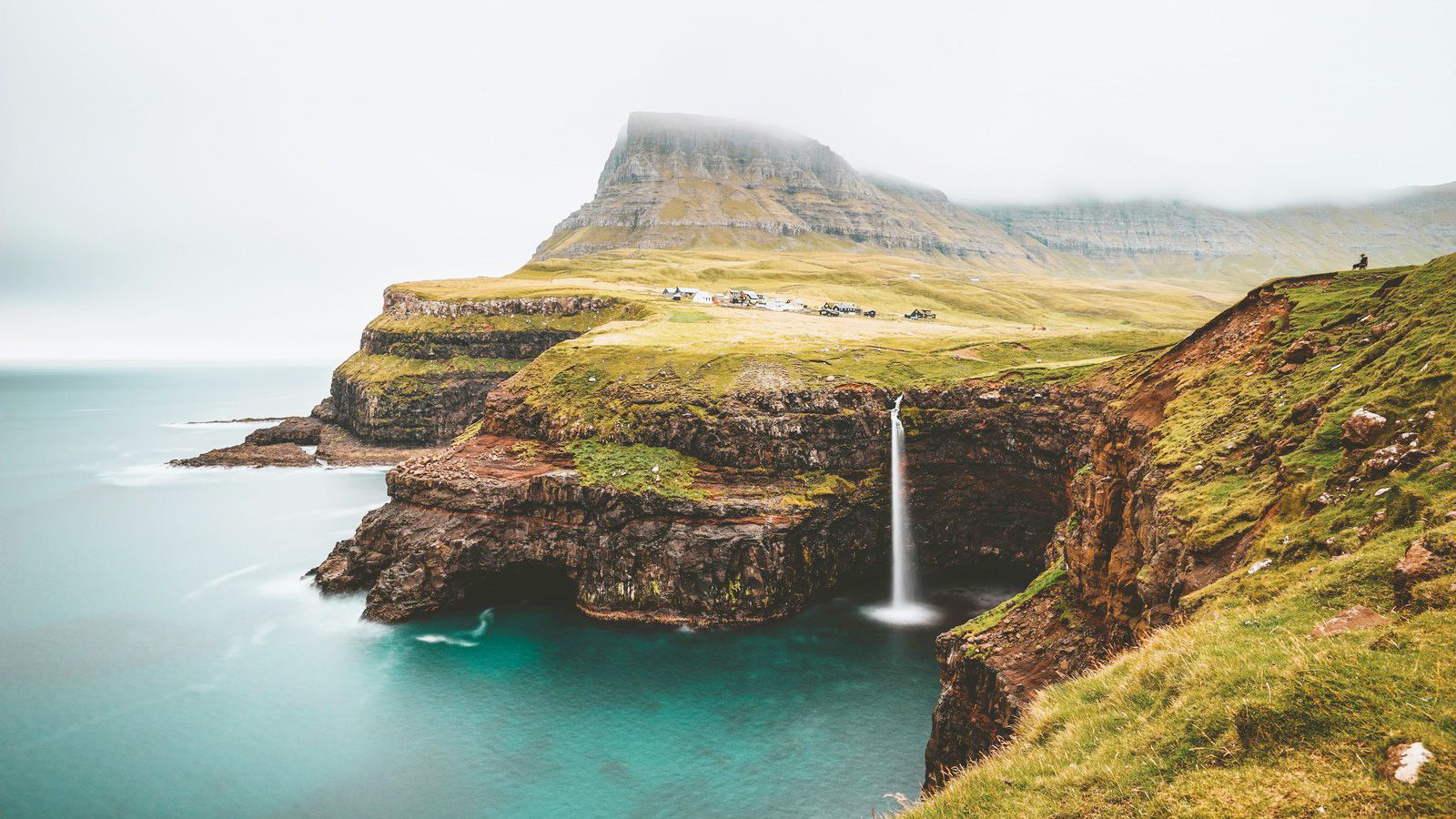
Tórshavn, the small capital, and the larger towns have reliable signal — Klaksvík on Borðoy, Runavík on Eysturoy, and Tvøroyri down on the southern island of Suðuroy. Coverage extends along the main road network and through the tunnels surprisingly well, and most of the villages on the more accessible islands are covered too. Where you'll lose signal is precisely the scenery people come for: the high mountain hiking trails, the towering sea cliffs at Vestmanna, the puffin colonies and the boat or helicopter trip out to remote Mykines, and the crossings to the smallest, sparsely populated outer islands. Mykines in particular is genuinely off-grid. Given how fast Faroese weather turns, the sensible move is always to download offline maps before any hike — you do not want to be route-finding on an exposed ridge in sudden fog with no signal and no cached map.
How much data you'll need
Faroese travel is light on data, and the rhythm of a trip here is dictated by weather rather than screens. You'll use Google Maps for the tunnel-and-fjord road network, a weather app more or less constantly because the forecast genuinely decides what you can do each day, WhatsApp for guesthouse hosts and boat operators, plus photos and a bit of social once you're back on Wi-Fi in the evening. A few days is comfortable on around 3-5 GB. A week touring the islands runs roughly 6-12 GB. It helps to download timetables in advance, too, since reaching the smaller islands often means a scheduled ferry or the subsidised inter-island helicopter, and you don't want to be checking departures on a flaky connection at the quay. Heavy streamers or remote workers should size up, but most visitors find they use less than expected simply because so much time is spent hiking or driving through spectacular, signal-free terrain. The plans above show the live options, and you can top up if you run short.
Keep your number and WhatsApp
No need to drop your usual number. A dual-SIM phone runs the eSIM next to your home SIM: the eSIM carries data while your normal line keeps calls, SMS and bank one-time codes, and WhatsApp stays on your existing number. Because the Faroes sit outside EU roaming, the important step here is switching your home SIM's data roaming off, so it can't quietly connect at off-zone rates while the eSIM does the actual work. That one toggle keeps the trip at a flat, known cost.
Before you fly
Confirm your phone is eSIM-ready — most iPhones from the XR onward, plus recent Samsung, Pixel and other current models — with our compatibility checker. Install on home Wi-Fi a day or two before departure; the plan stays dormant until you first connect on the islands. It activates as you land at Vágar Airport (FAE), the Faroes' only airport, so you're online for the scenic drive — through the sub-sea tunnel — across to Tórshavn.
Routing via Denmark or Iceland?
Most travellers reach the Faroes through Copenhagen or Reykjavík, and those legs are billed as separate zones — Denmark is in the EU, while the Faroes and Iceland are not — so check that whatever plan you buy actually lists each place you'll need data, rather than assuming one Nordic plan blankets them all. For a Faroes-only trip, the island-specific plan keeps it simple and avoids any roaming surprises.