
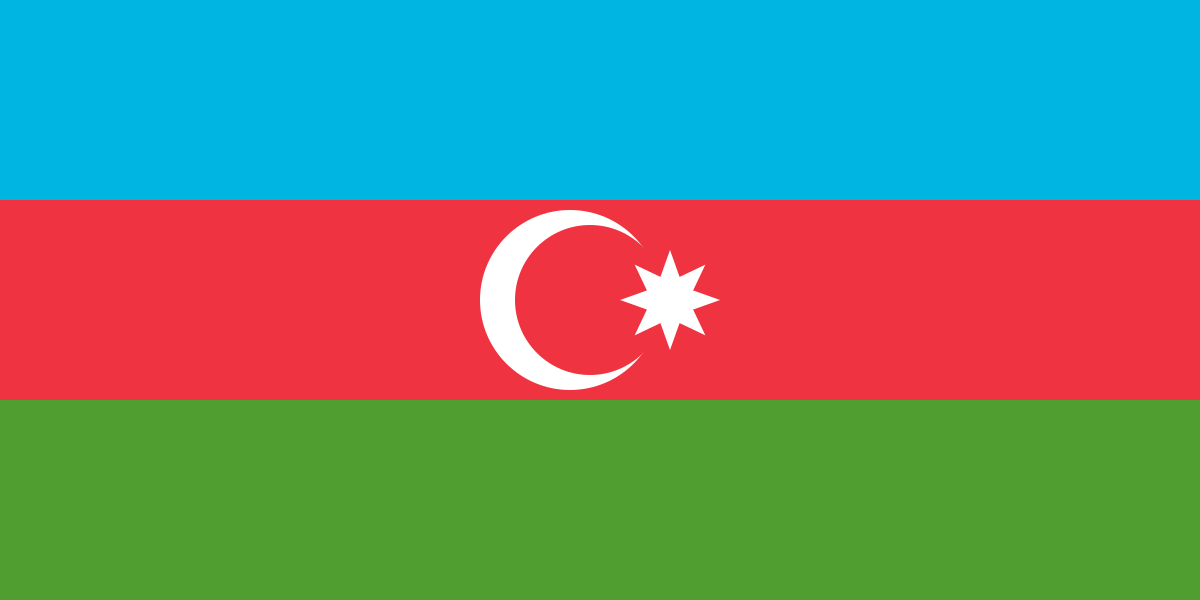









Using mobile data in Azerbaijan: what to expect
Azerbaijan's three operators — Azercell, Bakcell and Nar — cover the country well on 4G, with 5G live in parts of Baku. Across the capital, the walled Icherisheher old town, the Flame Towers district and along the Caspian seafront boulevard, data is fast and steady for maps, messaging, ride-hailing and uploading photos. A travel eSIM is the easy route here for a specific reason: buying a local SIM means passport registration, and Azerbaijan also operates IMEI device registration, so a foreign phone running a physical Azerbaijani SIM can get blocked from the networks after a short grace period unless you register the handset. An eSIM rides the operator's roaming layer instead — there's nothing to register, no kiosk queue and no paperwork, and the plan price stays flat. For a short city break or a Caucasus loop, that removes the single most annoying piece of friction travellers hit here.
Coverage across Azerbaijan
The strongest, most consistent signal sits in and around Baku and the Absheron Peninsula — the capital, the industrial town of Sumqayit and the coastal settlements. Major regional centres are well served too: Ganja in the west, and Gabala and Sheki in the green northern foothills, both popular for their mountain scenery and old caravanserais. The Caspian resort strip holds up fine. Where coverage genuinely thins is the high country — the Greater Caucasus villages around Xinaliq and Laza, the switchback mountain roads, and long stretches of highway through the central steppe between cities. Travel to the Nakhchivan exclave — separated from the rest of the country by Armenian territory and reached by air — is its own connectivity picture. Pull up offline maps before any mountain drive, because the gaps are exactly on the scenic routes you'll want to explore. The fire temple at Ateshgah and the burning hillside of Yanar Dag on the Absheron stay within good range, but the deeper you push into the mountains the more you'll rely on cached maps rather than live data.
How much data you'll need
Azerbaijan travel is fairly light on data. The apps you'll actually lean on are Google Maps and the locally popular 2GIS for navigation, Bolt for cheap and reliable city rides, WhatsApp and Telegram for messaging, and Google Translate's camera for Azerbaijani and Russian signage. A rough guide: a long weekend in Baku is comfortable on around 3-5 GB; a week pairing Baku with Sheki, Gabala and a Gobustan petroglyphs day trip lands around 8-15 GB; heavy streaming or working on the road is easiest on an unlimited-style plan. You'll see the live options in the plans above — start mid-range if you're unsure and top up if needed, which takes a moment.
Keep your number and WhatsApp
There's no need to drop your home number for an Azerbaijani data line. A modern dual-SIM phone runs the eSIM alongside your normal SIM: the eSIM carries data while your usual number keeps calls, SMS and bank one-time codes, and WhatsApp stays on your existing number with no re-verification. Just turn your home SIM's data roaming off so it can't quietly run up charges while the eSIM does the work. That also neatly sidesteps the IMEI issue — your home number is roaming, not registered locally, so nothing gets flagged.
Before you fly
Confirm your phone supports eSIM first — most iPhones from the XR onward, plus recent Samsung Galaxy, Google Pixel and Honor models; our compatibility checker verifies it in seconds. Buy and install on home Wi-Fi a day or two before departure; the plan stays dormant and activates when you first connect after landing at Baku's Heydar Aliyev International Airport (GYD). If Azerbaijan is one leg of a wider Caucasus trip, plan for how you'll stay connected when you cross a border, since regional roaming rules here aren't the EU's.
Touring the Caucasus?
Many travellers pair Azerbaijan with neighbouring Georgia on a single overland loop, often entering Georgia by the Lagodekhi or Red Bridge crossing. Picking up a separate Georgia plan when you cross keeps you online without swapping SIMs — and because eSIMs install over the air, you can add the next country's plan straight from your phone the night before you move on.